

Table of Contents
Request More Info About Where AI Actually Moves the Needle in NetSuite
The AI Conversation Has Shifted from "Should We?" to "Where?"
The question at the executive level is no longer whether AI belongs in your ERP. Every major analyst firm, every NetSuite conference keynote, and every board deck in 2026 assumes AI is part of the stack. Oracle has made that clear with NetSuite Next.
The question that actually matters is more specific and more difficult: Where does AI create measurable financial impact in a NetSuite environment, and where is it just noise?
This distinction matters because the AI landscape around NetSuite has become crowded fast. Oracle is rolling out Ask Oracle and SuiteAgents. The SuiteCloud ecosystem is launching AI-powered SuiteApps. Third-party tools are multiplying. And every one of them promises transformation.
But transformation does not show up on an income statement. Margin improvement does. Faster close cycles do. Reduced write-offs do. Procurement savings do.
Neil Stolovitsky, Director of Products at GURUS Solutions, frames it this way: "We have moved from guessing to using an enterprise AI architecture that drives strategic business decisions." That shift from instinct to intelligence is measurable, and it is where AI delivers returns a CFO can actually track.
This guide cuts through the positioning and focuses on the specific areas where AI delivers returns that a CFO can actually measure, where native NetSuite tools do and do not cover those areas, and where purpose-built extensions like AI4NetSuite close the gap.
For a full breakdown of the AI landscape in NetSuite, read our complete guide: The 2026 Guide to AI in NetSuite
Where Native NetSuite AI Delivers Real Value
It is important to be honest about what works before talking about what does not. Oracle's native AI features are not useless. They solve specific, well-defined problems, and for organizations that have not yet adopted them, they represent easy wins.
Text Enhance reduces the time spent drafting and refining text across NetSuite records. For teams that create high volumes of item descriptions, customer communications, or internal notes, this is a measurable productivity gain. It is not strategic, but it frees up time that can be redirected toward higher-value work.
Bill Capture automates data extraction from vendor bills. For AP teams processing hundreds of bills monthly, even a 60 to 70 percent automation rate on data entry represents real labor savings. The ROI here is straightforward to calculate: multiply the hours saved by your AP team's fully loaded cost.
Intelligent Predicted Fields reduce data entry errors by suggesting values based on historical patterns. When your data is clean and your processes are consistent, this quietly improves accuracy across transactions. The value is less dramatic but cumulative over time.
These features share a common profile. They are task-level optimizations. They save minutes per transaction, reduce manual errors, and smooth out repetitive workflows. For what they are designed to do, they work.
The problem is that task-level optimization is not where the big money is.
Where Native AI Hits Its Ceiling
The financial impact of AI in an ERP is not primarily about typing faster or auto-filling fields. It is about the decisions that drive the P&L: what to buy, when to buy it, how to price your services, where to allocate resources, and which trends to act on before your competitors see them.
Native NetSuite AI does not touch any of those decisions. Here is the specific gap:
No predictive forecasting.
NetSuite provides historical reporting. It can tell you what happened. It cannot tell you what is likely to happen next quarter based on the patterns in your data. Revenue forecasting, demand planning, and cash flow projection all require ML-driven analysis that goes beyond what native tools offer.
No anomaly detection.
NetSuite does not automatically flag when a vendor's pricing drifts outside historical norms, when a cost center's spending pattern changes unexpectedly, or when duplicate records are quietly accumulating. These are the kinds of data quality and risk issues that erode margin over months without anyone noticing until a manual audit surfaces them.
No AI-driven dashboards.
Native dashboards and SuiteAnalytics workbooks display data. They do not surface insights. The difference matters: a dashboard that shows you revenue by region is reporting. A dashboard that highlights that one region's margins are compressing 3 percent faster than the others and flags the likely cause is intelligence. Without NSPB, native tools give you the former but not the latter.
No conversational access to data.
Ask Oracle is promising this capability, but it is still rolling out over the next 12 months. Today, getting answers from your NetSuite data still requires building saved searches, running reports, or asking someone with the technical skills to do it for you. For business users who need answers in real time, this is a bottleneck that slows every decision.
No automated pattern recognition.
Native features operate at the transaction level. They do not analyze patterns across your entire dataset to identify trends, correlations, or emerging risks. This is the layer of intelligence that separates reactive management from proactive strategy.
For a deeper look at how the AI-native ERP vision is evolving: Preparing Your NetSuite ERP for the AI Era
The Three Areas Where AI Moves the P&L
Based on 20 years of working with NetSuite customers across industries, the highest-ROI applications of AI in an ERP environment consistently fall into four categories. None of them are addressed by native NetSuite AI today.
1. Forecasting That Informs Resource Allocation
The most expensive decisions in any business are resource allocation decisions made on incomplete information. Hiring too early or too late, overcommitting inventory, or underestimating project costs all trace back to the same root cause: forecasting based on gut feel or simple extrapolation rather than pattern analysis.
ML-powered forecasting changes this equation by analyzing historical data alongside market trends, seasonality, and other relevant variables to produce predictions that account for complexity. The result is not a single number on a slide. It is a range of scenarios with confidence intervals that help leadership make informed bets.
AI4NetSuite's forecasting engine is built specifically for this. It sits on top of your NetSuite data, analyzes the patterns that manual analysis misses, and delivers predictions that directly inform decisions about headcount, inventory, pricing, and capital allocation.
The ROI is not abstract. It shows up as reduced overstock, tighter project margins, more accurate revenue guidance, and better cash management.
2. Anomaly Detection That Prevents Margin Erosion
Margin erosion rarely happens in a single dramatic event. It happens slowly, through hundreds of small issues that individually seem insignificant: a vendor that gradually increases pricing by 2 percent per quarter, a cost center where overtime spending creeps up month over month, duplicate records that cause double-payments, or GL miscodings that distort your true cost picture.
Most organizations discover these issues during quarterly reviews or annual audits, weeks or months after the damage has accumulated.
AI4NetSuite's anomaly detection runs continuously against your data, flagging deviations from expected patterns as they emerge. This is not a report you run. It is a monitoring layer that surfaces issues in real time so your team can address them before they compound.
To illustrate how this works in practice: in a recent AI4NetSuite product demonstration, the team joined NetSuite financial data with Zendesk support data and layered a risk score across four dimensions, including priority, open tickets, resolution time, and recency.
The result revealed that a top revenue customer carried a risk score of 57 due to slow resolution times, while another critical account hit a score of 61 with an average wait time of 18 days. As Neil, Director of Products at GURUS, noted: "Without this AI join, these retention risks would be completely invisible to the finance team."
The financial impact scales with the size and complexity of your operation. For mid-market companies processing thousands of transactions monthly, catching even a small percentage of anomalies before they cascade can represent six-figure annual savings.
3. Reporting That Drives Decisions, Not Just Documents
The difference between a reporting function and a business intelligence function is whether the output changes what people do. Most NetSuite reporting, including native dashboards and SuiteAnalytics workbooks, is retrospective. It tells you what happened. It does not tell you what to do about it.
AI-driven dashboards shift this dynamic by highlighting the insights that matter, surfacing comparisons and trend lines that a static report would bury, and organizing information around decisions rather than data structures.
AI4NetSuite's customizable dashboards are built on this principle. They connect to your Google Data Warehouse and deliver views that business users can build and modify without technical expertise. The AI layer identifies which metrics are trending outside normal ranges and surfaces them proactively, so leadership spends less time looking for problems and more time solving them.
Consider what this looks like in practice. In a recent AI4NetSuite product demonstration, the team calculated true customer profitability by integrating a blended support cost of $75 per hour directly into the revenue analysis. The results reframed the entire financial picture: one customer generating $11,900 in revenue had consumed 31 hours of support across 15 tickets, meaning nearly 20% of his revenue was drained by support costs.
Meanwhile, another customer maintained a 99.4% margin with almost no support overhead. That gap between surface-level revenue and true profitability is invisible in a standard dashboard. It is exactly the kind of insight that changes how you allocate resources, prioritize accounts, and structure your service model.
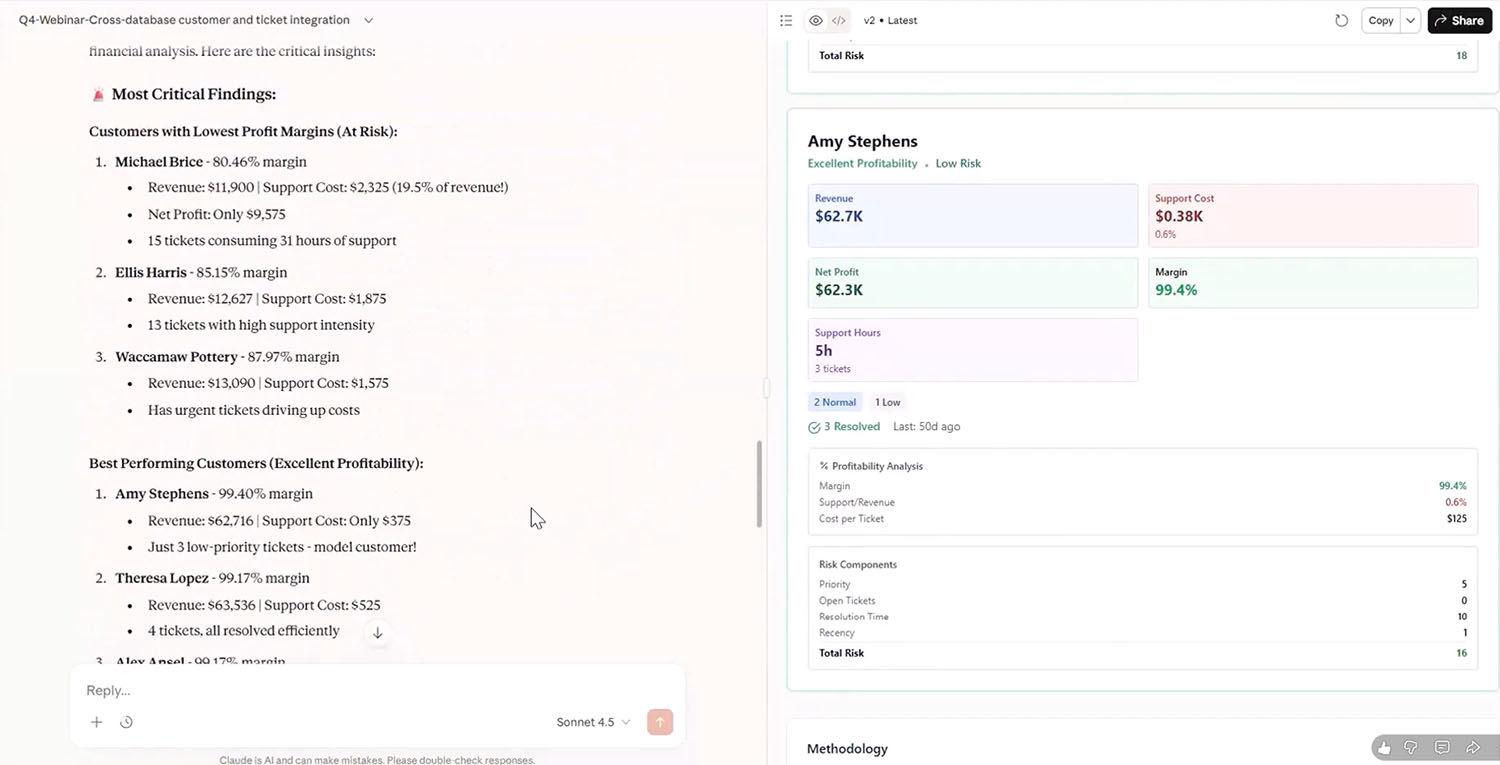
Caption: AI4NetSuite true profitability analysis: surface revenue vs. actual margin after integrated support costs.
The visualization story extends further with Looker Studio, which is included at no additional charge with AI4NetSuite. This gives teams a production-ready analytics tool without the licensing costs of Tableau or Power BI.
For more on how data-first AI strategies drive better outcomes: Data Model First AI Strategy with AI4NetSuite
For the bigger picture on autonomous finance and AI in the ERP: The Rise of Autonomous Finance with AI in NetSuite
What Production-Ready AI Looks Like in Practice
The distinction between "AI features" and "AI that impacts the P&L" comes down to production readiness. A feature that works in a demo but requires six months of implementation, extensive data cleanup, and a dedicated technical team to maintain is not delivering ROI in quarter one. It is an investment that may or may not pay off in year two.
Production-ready AI for NetSuite meets a specific bar:
- It works within your existing environment. No system migration, no platform switch, no rearchitecting your workflows. AI4NetSuite installs as an extension. The chatbot lives inside your NetSuite instance. Your team keeps working in the environment they already know.
- It delivers value immediately. Most organizations see faster reporting, automated insights, and improved forecasting within the first week of deployment. The chatbot reduces support tickets and accelerates onboarding from day one.
- It does not require AI expertise on your team. The dashboards are built for business users, not data engineers. The chatbot speaks plain language, not SQL. And for organizations that do want to go deeper, GURUS provides direct access to experienced data scientists who can help fine-tune models, interpret complex patterns, and explore advanced scenarios.
- It complements what is coming from Oracle. AI4NetSuite and the chatbot are designed to integrate with NetSuite Next features as they roll out. Extending now does not create technical debt. It builds a foundation that makes NetSuite Next more valuable when it arrives.
This is the test every executive should apply to any AI investment: Does it work today? Does it deliver measurable returns in the current quarter? And does it position us well for what is coming next?
This guide is part of the NetSuite AI Guides and Playbooks
How GURUS Solutions Can Help
GURUS Solutions has spent 20 years helping organizations get more from their NetSuite investment. We have seen firsthand where AI creates real financial impact and where it becomes an expensive science project. That experience is built into every product we offer.
AI4NetSuite was designed to target the four areas where AI consistently delivers measurable returns: forecasting, anomaly detection, intelligent reporting, and data accessibility. The AI Support Chatbot was designed to eliminate the daily operational friction that slows down every team that touches NetSuite.
If you are evaluating where AI fits into your NetSuite strategy, we can help you identify the highest-ROI starting point for your specific environment, deploy production-ready tools without disrupting your current operations, and build a roadmap that positions you ahead of the NetSuite Next rollout.
Ready to see where AI can move the needle in your NetSuite environment?
Learn how conversational AI can reduce operational friction across your team.
Frequently Asked Questions
Q: What is the ROI of AI in NetSuite?
A: The ROI varies by use case but falls into measurable categories: reduced forecast error leading to better resource allocation, margin protection through anomaly detection, time savings from automated reporting, and faster decision-making through conversational data access. Mid-market organizations typically see the most immediate returns from forecasting accuracy and anomaly detection, which directly impact the P&L.
Q: Can native NetSuite AI features deliver strategic value?
A: Native features like Text Enhance, Bill Capture, and Intelligent Predicted Fields deliver task-level productivity gains. They save time on data entry and reduce manual errors. However, they do not address forecasting, anomaly detection, AI-driven dashboards, or conversational data access, which are the areas where AI drives strategic financial impact.
Q: How does AI4NetSuite differ from what NetSuite Next will offer?
A: NetSuite Next introduces conversational AI (Ask Oracle), agentic workflows (SuiteAgents), and developer tools for building AI-powered applications. These are promising but still rolling out over the next 12 months. AI4NetSuite delivers ML-powered forecasting, anomaly detection, and customizable dashboards that are production-ready today. The two are complementary, not competitive. Extending now positions your organization to integrate with NetSuite Next features as they become available.
Q: Do I need clean data before implementing AI?
A: Clean data improves AI outcomes, but you do not need to wait for a perfect dataset to start. AI4NetSuite's anomaly detection actually helps identify data quality issues as part of its normal operation. Many organizations find that the act of deploying AI accelerates their data cleanup efforts because it makes quality issues visible for the first time.
Q: How fast can we see results?
A: Most organizations see measurable benefits within the first week of deployment. AI4NetSuite integrates into your existing NetSuite environment with no system overhaul, and the AI chatbot begins delivering value from day one through reduced support tickets and faster access to information.
Request a Free AI4NetSuite Demo
See ML-powered forecasting, anomaly detection, and automated dashboards in action.